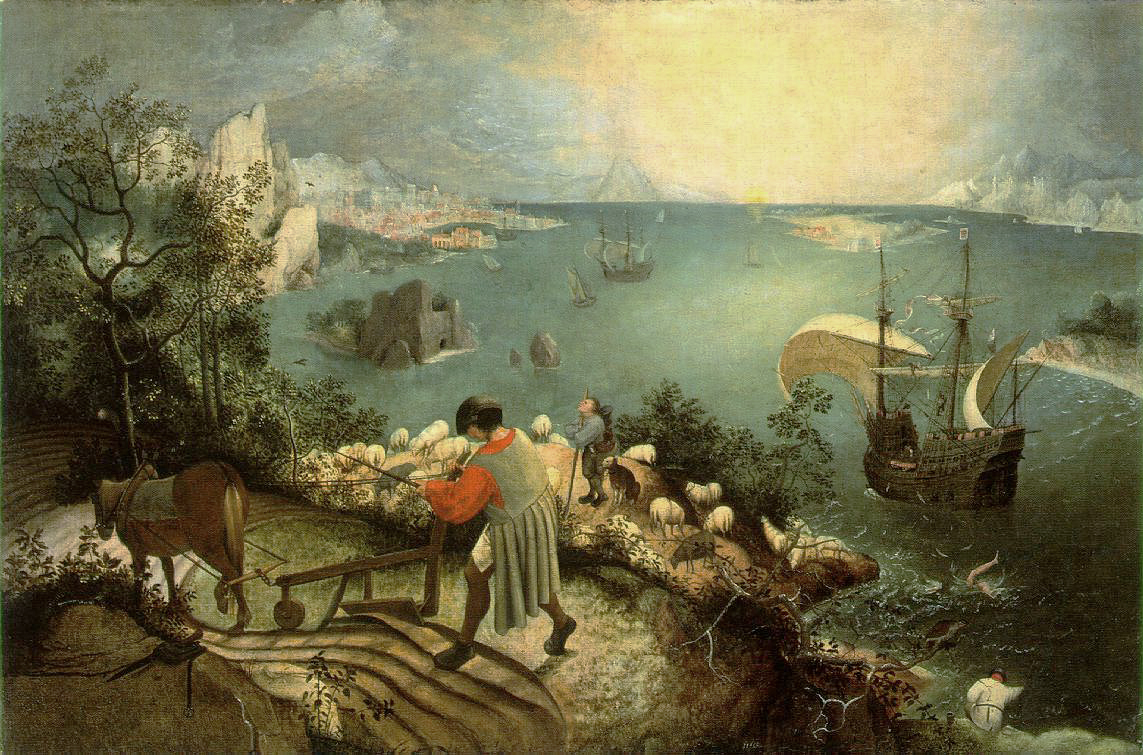
Wm. Bliss Carman's poem 'The Blue Heron' from his Later Poems has left me unsatisfied in many ways. Perhaps some critic or scholar has noted its resemblance to both a triptych and to the 'Icarus' painting of the elder Bruegel ('Landscape with the Fall of Icarus'.)
The mower is 'among' the hay - not as an insect or frightened rabbit - and the horses are being worked in the heat of day, rather than mowing the hay in the morning and later afternoon. This is hay, not a cash crop in danger of frost. He may not have known the cycle of farm labour.
The meadow lilies may be there in July, but for me they are late July and August. And are they being mowed down, or does he take hay to be in a worked field, and not a meadow?
In July, the heron should have a mate and a fledged chick - it is not a loner soaring where the river may carry it. The patient stalker was not merely 'among the reeds'. Or are we to go from Moses to the shepherd and his flock? What were these trees in the Breugel?
These would not be concerns if it were not the argument of the poet which depends on his grasp of what is transpiring about him, both what is before him as evanescent and what is before him as cyclic, as unreal and as real.
The Breugel appeared in 1912 and this volume in 1922 (Auden on Icarus stems from 1938.)
Friday, December 31, 2010

Monday, December 13, 2010
Evolution Pleasure
The opposed thum and the phonological oppositions could be thought of as solving certain problems facing the evolution of organisms.
In that vein, suppose that the emergence of pleasure and pain solve a certain problem in the evolution of mobile animals that does not arise for more static plants. What problem, then, would be addressed by the emergence of consciousness?
In that vein, suppose that the emergence of pleasure and pain solve a certain problem in the evolution of mobile animals that does not arise for more static plants. What problem, then, would be addressed by the emergence of consciousness?
Sunday, December 12, 2010
In memory of an existentialist clinician and his children
the existentialists on their children
Nietzsche on his son, Hugo, as a middle child
Kierkegaard on his oldest daughter, Sarah
de Beauvoir on her youngest daughter, Claire
When Richard (Dick) Eaton Johnson was working on his book on Henri Bergson - a book he abandoned for an effort to write a book on Karl Jaspers - he was writing with two young children at home.
An existentialist reading of Bergson as an author treating lived-temporality has an awkward moment - my relation with my adult child - even my grey-haired adult offspring - is not my relation with a child. There is the extreme border case of my relation to the dying child - or the young child to the dying parent - but in the normal case (oh, a troubling notion, that) this is not the relation to the growing child.
There is the case of the male existentialist author and his young bride: as a mature woman she may have quite a different relation to her former husband and his young companion. But from age 2 to 10 this is not the manner of disruption/irruption/rupture usually characteristic of a healthy relation of
parent to child. 'Healthy', I say, for having been free of violence verbal or physical, whether as victim or witness; for having been free of threat of starvation, loss, pointless separation or complete lack of privacy or lack of other respect of boundaries as accepted in a cultural community. And a child not ridiculed before peers or shamed before peers without provocation or cause. And a child not exposed to wanton drunkeness as a daily regimen.
Gabriel Marcel has written of the child, but who was the child Isaac to Kierkegaard? Or the child Jeshua, later called 'the Nazarene', an itinerant stone-cutter, preacher, healer - and even if not of his own choosing - prophet.
Not that we have always had our notions of child, teen, single young adult woman, single mature woman, bored retiree, retired female executive.
What we do now have is a spectrum of relations of parnet to child charateristic of Aspergers and varying degrees and styles of autism. This might have given the existentialist pause. These are neither extreme of the prodigee, the genius or the psychotic or simply demonically evil.
What will count as a cure for the existentialist child psychiatrist? Would it not be a more or less normal relation of the child to parent? But what about the child's independence and relation to arbitrary school children - the normal lot in urban life?
What we come to here is repetition: the parent reports that her child brought her flowers and said,
* To report is not to recount. In recounting I often repeat myself, or even mistake the context. What I recount about my child, most often my wife has heard me tell before. [ to be continued ]
Nietzsche on his son, Hugo, as a middle child
Kierkegaard on his oldest daughter, Sarah
de Beauvoir on her youngest daughter, Claire
When Richard (Dick) Eaton Johnson was working on his book on Henri Bergson - a book he abandoned for an effort to write a book on Karl Jaspers - he was writing with two young children at home.
An existentialist reading of Bergson as an author treating lived-temporality has an awkward moment - my relation with my adult child - even my grey-haired adult offspring - is not my relation with a child. There is the extreme border case of my relation to the dying child - or the young child to the dying parent - but in the normal case (oh, a troubling notion, that) this is not the relation to the growing child.
There is the case of the male existentialist author and his young bride: as a mature woman she may have quite a different relation to her former husband and his young companion. But from age 2 to 10 this is not the manner of disruption/irruption/rupture usually characteristic of a healthy relation of
parent to child. 'Healthy', I say, for having been free of violence verbal or physical, whether as victim or witness; for having been free of threat of starvation, loss, pointless separation or complete lack of privacy or lack of other respect of boundaries as accepted in a cultural community. And a child not ridiculed before peers or shamed before peers without provocation or cause. And a child not exposed to wanton drunkeness as a daily regimen.
Gabriel Marcel has written of the child, but who was the child Isaac to Kierkegaard? Or the child Jeshua, later called 'the Nazarene', an itinerant stone-cutter, preacher, healer - and even if not of his own choosing - prophet.
Not that we have always had our notions of child, teen, single young adult woman, single mature woman, bored retiree, retired female executive.
What we do now have is a spectrum of relations of parnet to child charateristic of Aspergers and varying degrees and styles of autism. This might have given the existentialist pause. These are neither extreme of the prodigee, the genius or the psychotic or simply demonically evil.
What will count as a cure for the existentialist child psychiatrist? Would it not be a more or less normal relation of the child to parent? But what about the child's independence and relation to arbitrary school children - the normal lot in urban life?
What we come to here is repetition: the parent reports that her child brought her flowers and said,
"These are for you - do you like them?"What is key is that she reports* this. And if this were one singular instance, never repeated, and before no witness? Here is the nexus where Spinoza and Hume collide with Heidegger and in which we can see most clearly that Jaspers was the existential clinician's philosopher.
* To report is not to recount. In recounting I often repeat myself, or even mistake the context. What I recount about my child, most often my wife has heard me tell before. [ to be continued ]
Sunday, November 7, 2010
Edmund Husserl versus Telescopium (Die Krisis der Eur'n Wiss'n)
Question: where in Krisis does Husserl indicate that he was aware that Galileo was looking through a spyclass at Venus and Jupiter and not through a Keplerian-style inverting refractor telescope? My copy and the English translation are packed away in a box until that day when I again have some office space ...
Fernglas?
Teleskop?
The former was of particular value to artillery officers prior to the calculus; see Galileo and the geometry of canon shots for best distance; see Husserl's naive stance on war during the early years of WWI (cp: B. Russell, same period)
See the use of optical transit with howitzer altititude and azimuth positioning through both Korea and Vietnam.
Transit and land surveying versus the forester's compass for the German managed woodlot: example, Marburg Lahntal opposite the old university in der naehe von Cappel.
Compare: GPS and digital alt-az encoders.
Google books Krisis
Google books Crisis
Historical note: Kepler's "observations" are not chiefly with a telescope. Cf: later use of "zenith telescope" and the last precision US Navy zenith telescope and its reliance on mechanics for its optical precision.
vide perspicillum
Fernglas?
Teleskop?
The former was of particular value to artillery officers prior to the calculus; see Galileo and the geometry of canon shots for best distance; see Husserl's naive stance on war during the early years of WWI (cp: B. Russell, same period)
See the use of optical transit with howitzer altititude and azimuth positioning through both Korea and Vietnam.
Transit and land surveying versus the forester's compass for the German managed woodlot: example, Marburg Lahntal opposite the old university in der naehe von Cappel.
Compare: GPS and digital alt-az encoders.
Google books Krisis
Google books Crisis
Historical note: Kepler's "observations" are not chiefly with a telescope. Cf: later use of "zenith telescope" and the last precision US Navy zenith telescope and its reliance on mechanics for its optical precision.
vide perspicillum
Friday, October 15, 2010
Octavio Paz
In the foreward to Piedra de sol Paz seems to state that the planet Venus is visible twice each day, morning and evening.
That is not the sense in which the Morning Star is, in fact, the Evening Star.
Perhaps those maintaining the ancient Mexican calendar would have appreciated Galileo's "spyglass" views of the cycles of Venus and her varying apparent diameter and their association with morning and evening.
From 45deg N. latitude in this 10th month of 2010, Venus and Saturn are both more than 10 degrees from the daytimne sun. But how to see them? Saturn sets moments before the sun and venus moments later due to their being now at about the same altitiude as the sun relative to the horizon.
It has been suggested that Venus cannot be seen in daylight when within 10 degrees of the sun - but their would be occasions when Venus as the "Evening Star" could be detected as a "Daytime star" and that Venus as the "Morning Star" could be successfully tracked during the day (as can be done with Jupiter this season?)
Mercury, however, is now so close to the sun as to be "gone" from the sky. Mars is to faint to be seen except duing a solar eclipse (?).
It would seem more likely that the Aztec's knew their Venus as a star of two cycles. And then there is the importance of the Pleiades and Doomsday (see Fray Bernardino de Sahagun.)
The Maya, in particular, (per Dreseden Codex?) allotted distinct time periods to the Venus no longer visible.
see: heliacal rising of Venus
Viewing daylight Venus link: http://www.fourmilab.ch/images/venus_daytime/
That is not the sense in which the Morning Star is, in fact, the Evening Star.
Perhaps those maintaining the ancient Mexican calendar would have appreciated Galileo's "spyglass" views of the cycles of Venus and her varying apparent diameter and their association with morning and evening.
From 45deg N. latitude in this 10th month of 2010, Venus and Saturn are both more than 10 degrees from the daytimne sun. But how to see them? Saturn sets moments before the sun and venus moments later due to their being now at about the same altitiude as the sun relative to the horizon.
It has been suggested that Venus cannot be seen in daylight when within 10 degrees of the sun - but their would be occasions when Venus as the "Evening Star" could be detected as a "Daytime star" and that Venus as the "Morning Star" could be successfully tracked during the day (as can be done with Jupiter this season?)
Mercury, however, is now so close to the sun as to be "gone" from the sky. Mars is to faint to be seen except duing a solar eclipse (?).
It would seem more likely that the Aztec's knew their Venus as a star of two cycles. And then there is the importance of the Pleiades and Doomsday (see Fray Bernardino de Sahagun.)
The Maya, in particular, (per Dreseden Codex?) allotted distinct time periods to the Venus no longer visible.
see: heliacal rising of Venus
Viewing daylight Venus link: http://www.fourmilab.ch/images/venus_daytime/
Sunday, July 18, 2010
Rainer Maria Rilke web links
Rilke web links:
Related:
Die Dritte Elegie
[…]
O des Blutes Neptun, o sein furchtbarer Dreizack.
O der dunkele Wind seiner Brust aus gewundener Muschel.
[…]
- http://picture-poems.com/rilke/rilkebio.html
- http://www.cup.es/us/catalogue/catalogue.asp?isbn=9780521879439&ss=cop
- http://www.rilke.ch/links/index.html
- http://www.unix-ag.uni-kl.de/~kasparek/Rilke/
Related:
- http://en.wikipedia.org/wiki/Neptune_%28mythology%29
- http://en.wikipedia.org/wiki/Uranus_%28mythology%29
Die Dritte Elegie
[…]
O des Blutes Neptun, o sein furchtbarer Dreizack.
O der dunkele Wind seiner Brust aus gewundener Muschel.
[…]
Monday, June 21, 2010
Hegel and Heidegger
One of the oddities of Heidegger's published works is the lengthy chapter from Hegel published in Heidegger's 1957 Holzwege. The small book includes the entire introductory chapter which follows Hegel's foreword to his Phenomenology of Spirit.
I have added a page at phil.aule-browser.com which contains both the entire passage and a viewport into the book Holzwege at Google Books. From month to month there is no saysing how many or which pages of the 1942/43 Hegel lecture will be visible at Google.
As with most other pages at aule-browser, this one requires the Curl browser plugin.
This is a rare chance to publish many pages of Heidegger with no concern for copyright on the German text of "Phaenomenologie des Geistes".
I will add an "aule" for selecting variant pages, such as a page with "Erfahrung" indexed.
Heidegger's works are notable for their lack of scholarly apparatus, such as a mere index of names or a bibliography. Such an apparatus would be a technique within the trappings of modern philosophy and was deemed in-the-way for "the path of thinking".
Had the French occupying forces denied Heidegger royalties from his wartime works or abrogated his copyrights, this would not be an issue today - but the published works remain in the hands of the Heidegger family.
I have added a page at phil.aule-browser.com which contains both the entire passage and a viewport into the book Holzwege at Google Books. From month to month there is no saysing how many or which pages of the 1942/43 Hegel lecture will be visible at Google.
As with most other pages at aule-browser, this one requires the Curl browser plugin.
This is a rare chance to publish many pages of Heidegger with no concern for copyright on the German text of "Phaenomenologie des Geistes".
I will add an "aule" for selecting variant pages, such as a page with "Erfahrung" indexed.
Heidegger's works are notable for their lack of scholarly apparatus, such as a mere index of names or a bibliography. Such an apparatus would be a technique within the trappings of modern philosophy and was deemed in-the-way for "the path of thinking".
Had the French occupying forces denied Heidegger royalties from his wartime works or abrogated his copyrights, this would not be an issue today - but the published works remain in the hands of the Heidegger family.
Subscribe to:
Posts (Atom)

 Posts
Posts